Handing work off
An issue’s tasks are its workshop: they do the work, one run after another, in the issue’s main worktree. What they produce still has to go somewhere — a pull request, a merge, a comment on the issue, a message to a team — and that step is a handoff. One integration task claims several finished issues and runs a workflow you choose over all of them, then records what became of each.
This page tells that story end to end: what a run delivers, when an issue is
ready, how a handoff claims it, the four outcomes, the marker a board shows,
and the grant that lets a handoff write to GitHub. The fields and routes are in
the API reference and the
CLI reference; this page is the story
behind them. A handoff is not
vincent chat handoff, which turns
a chat into a task.
Deliveries
A task’s delivery is what its run produced. It has a kind:
change, the default — commits on the task’s branch, to be integrated.reply— an answer, a refusal or questions, to be posted where the work came from. This is how a workshop ends in words: “needs info”, “won’t fix”.none— the run produced nothing to hand on.
A step records one while the task runs, the way it reports its status:
vincent task deliver --title "Retry the upload on a 503" --body-file pr.md --summary-file brief.md
It takes a title and a Markdown body (what a pull request or a comment would
say), a summary, the commit the run verified (--head; the branch tip by
default), a suggested close reason for the issue and the proof. The same call
is POST /v1/tasks/{id}/delivery over the API and task_deliver over
MCP, which is the route a step in a container uses.
You rarely need it for a plain change. A task that reaches done without
recording a delivery gets an implicit one: change when its branch holds
commits its base does not, none otherwise, titled and described by the task.
A later call replaces the delivery, a follow-up that re-runs a finished task
clears it, and a merge-back task delivers its side task’s delivery — so the
delivery always describes the run that last finished. Each change emits
task.delivery_changed.
See Deliveries for every field and
vincent task deliver for the
flags.
Ready to hand off
An issue moves to the hand_off lane when nothing of it is
running and its latest finished main-line delivery is ready. The workflow
decides that at → done, with its
hand_off key:
auto, the default, marks the delivery ready — the issue reacheshand_offas soon as its work finishes.explicitmarks it not ready, unless a step ranvincent task deliver --ready. Use it for a spike or a research workflow whose result a person judges first, or one that decides in a step.
An in-progress issue whose finished work is not ready is idle: nothing is
running and nothing moves on its own. A person decides with
vincent issue ready <id>, which moves it to hand_off, or
vincent issue unready <id>, which takes a hand-off issue back to
in_progress (. on its card in the TUI does either). Both are local
writes, never sent to GitHub. See
Ready to hand off for what each
refuses.
Starting a handoff
A handoff runs a workflow that declares
role: handoff. Nothing else runs
one, and a handoff runs nothing else: there is no default handoff workflow.
Name the issues, or let the handoff choose them:
vincent handoff start --project 1 --workflow merge-train 12 14 15
vincent handoff start --project 1 --workflow merge-train --delivery change --label ready-to-ship --max 8
A selection takes the eligible issues — open, in hand_off, claimed by no
other handoff, and with a delivery not already delivered — most urgent first,
then the oldest delivery. One call creates the handoff, its task and every
claim, or nothing: an id that is not eligible, or a selection that finds
nothing, creates no task. POST /v1/handoffs is the same over the API.
The handoff’s task is an ordinary root task with no issue, cut from the
project’s base branch. Its steps read the claimed items from
.Handoff or from the file at
$VINCENT_HANDOFF_FILE —
the handoff’s id, its grant, and per item the issue, its delivery, and the
delivering task’s id, branch and verified head.
A claim is exclusive. While a handoff claims an issue, it belongs to that
handoff: a new task on it, a chat hand-off or a follow-up is refused
issue_in_handoff, and only the handoff’s own task may add work to it.
vincent handoff ls lists handoffs (--issue finds every one that claimed an
issue), and vincent handoff show <id> prints one with its items. A handoff
is live while its task runs, waiting once the task has settled with an item
still waiting, and settled otherwise.
Outcomes
Each claimed issue ends with one of four outcomes, recorded by a verb — run by the handoff’s own steps, or by you:
| Verb | Outcome | What happens to the issue |
|---|---|---|
vincent handoff deliver |
delivered |
Closed with --close — the delivery’s suggested reason, else completed. --close none leaves it open, kept out of later handoffs until new work replaces the delivery |
vincent handoff return |
returned |
The claim is dropped and its readiness withdrawn, so it waits in in_progress. --follow-up queues a prompt on the issue’s main task; with --side, as a new side task merged back into the main branch |
vincent handoff wait |
waiting |
Parked on something outside the handoff. It keeps its claim after the task settles, and closing the issue — by anyone, a GitHub import included — records it delivered |
vincent handoff release |
released |
The claim is dropped with no verdict; the issue stays eligible for a later handoff |
Each verb takes the handoff, then one issue id, several, or --all (every
unresolved item; waiting ones are left alone). --note is kept on the item,
and --comment-file posts a comment on each issue before anything else is
written to it:
vincent handoff deliver 3 12 14 --close completed
vincent handoff wait 3 15 --note "waiting on the vendor's fix"
vincent handoff return 3 15 --follow-up "Rebase onto the new API and retry"
A call is all or nothing: one refused item records nothing for any of
them. An item already resolved with a different outcome is refused
handoff_item_resolved; repeating an item’s own outcome succeeds and changes
nothing — its comment and close included — so a retried step converges rather
than posting twice. When the handoff’s task settles, every item still
unresolved is released. See Item outcomes.
The handoff marker
Beside its lane, an issue carries a handoff marker that says where it stands toward a handoff:
pending— inhand_off, unclaimed: a handoff may claim it now.claimed— a handoff holds it and has not decided it. It shows in any lane, because the handoff’s task may restart work on it.waiting— a handoff holds it, parked withhandoff wait.delivered— delivered and left open, until new work makes itpendingagain.idle— in progress, with finished work that is not ready.
While the claiming handoff’s task is paused, a claimed or waiting marker
says so (paused on the wire). vincent issue ls prints the marker in the
LANE cell and --handoff pending filters on it; the API spells it handoff
on each issue and takes ?handoff=. The full rule is the
handoff marker.
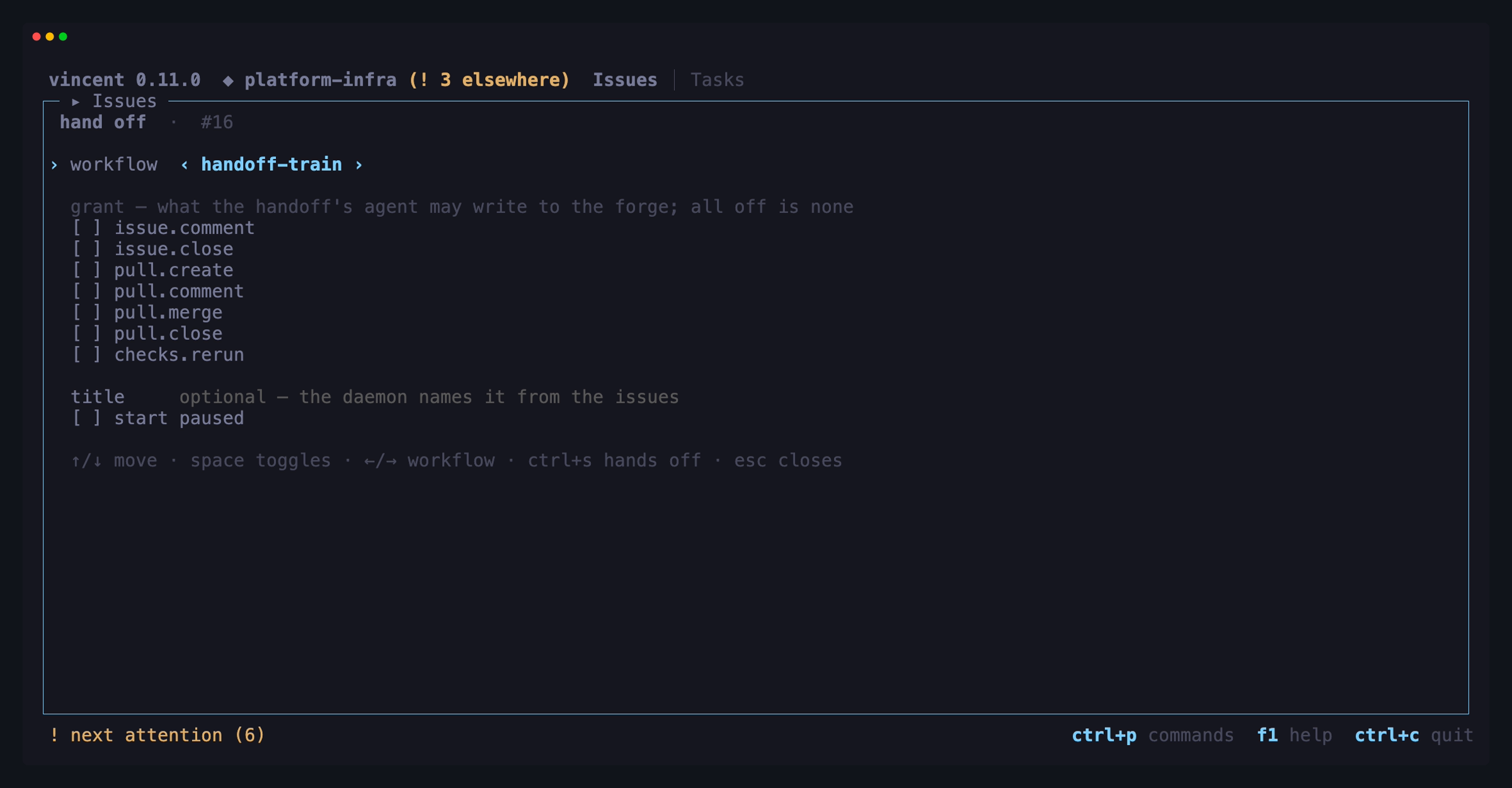
In the TUI, the issues board shows the
marker on each card. space selects a pending card, V every pending card,
and I opens the handoff form for the selection: the role: handoff workflow,
the grant, a title and whether to start paused.
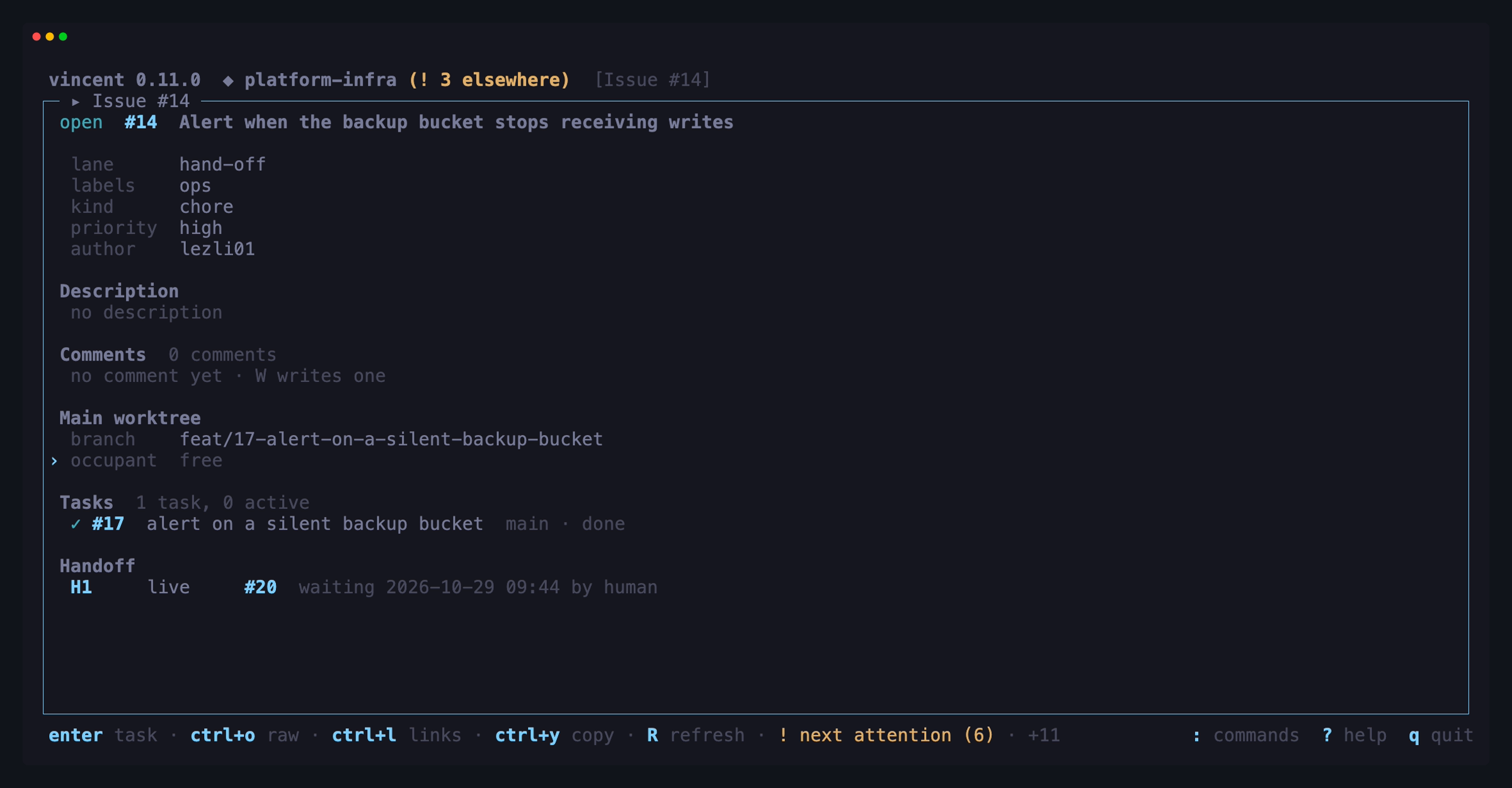
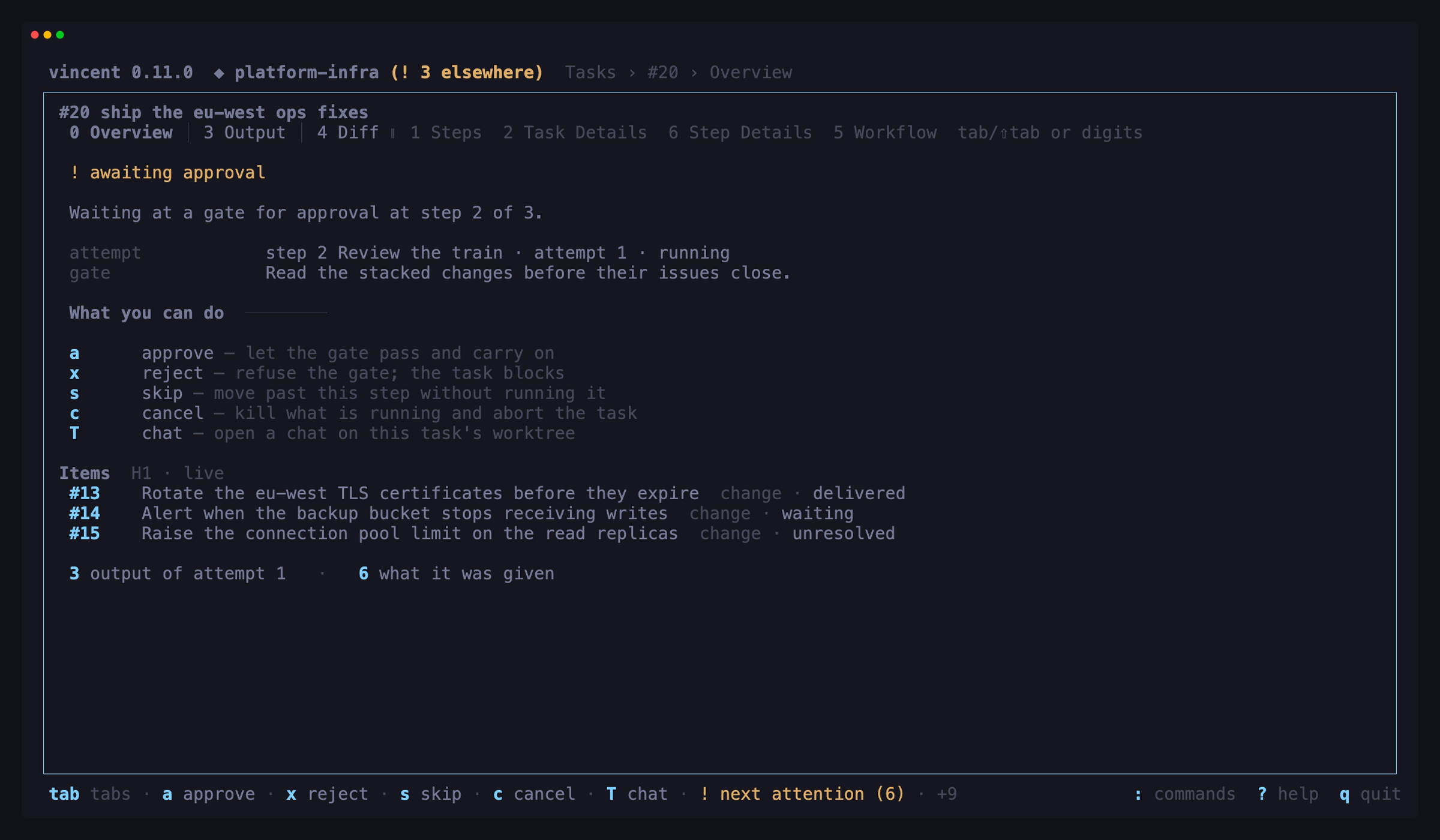
An issue’s detail names the handoff that holds it, and the handoff’s task lists its items with their outcomes:
Grants: letting a handoff write to GitHub
A workflow step that writes to GitHub through vincent — vincent github pr
create, merge, close, reopen, comment or rerun, or a close, a reopen or a
comment on an imported issue — is refused 409 forge_write_needs_human.
Nothing is sent. A grant is how you say yes in advance, for one handoff.
It names capabilities from a closed list:
| Capability | Lets the handoff’s task |
|---|---|
issue.comment |
Comment on its imported issues |
issue.close |
Close or reopen its imported issues |
pull.create |
Push an item’s branch and open its pull request |
pull.comment |
Comment on its pull requests |
pull.merge |
Merge its pull requests |
pull.close |
Close its pull requests |
checks.rerun |
Rerun its pull requests’ checks |
A granted write is admitted only from the handoff’s own task, and only on
the handoff’s own items and pull requests. It is made as handoff, not as
you, and queued for GitHub like any other write vincent makes. Every other
step — another task, a fan-out lane — is still refused.
Only a person gives a grant. An agent may start a handoff, but one that
asks for a grant is refused grant_needs_human. A person consents in one of
three places:
- On the command line, with
vincent handoff start --grant
pull.create,issue.close
— your own command. - In the TUI form, by ticking capabilities — they all start off — and
submitting with
ctrl+s. The keypress is the consent. - On a trigger, by arming it: a trigger’s
start_handoffaction carries agrant:, and arming the trigger with it is the consent for every handoff it starts. Adding a capability counts as arming, so it asks again (configuration has the rule).
The security model says what this check is and is not: it keeps an agent’s honest call off GitHub, but it is not a boundary against an agent running as you.
Breaking, from the release after v0.11.0. An ungranted
vincent github
pr
write from a workflow step or a chat agent used to be accepted as yours; it is now refusedforge_write_needs_human. A step’s owngh pr …in its worktree is unaffected. See the changelog.
Worked lifecycles
Each of these ships as a workflow you install with `vincent workflow init