Jira issue sync
A vincent project can take its issues from a Jira Cloud project instead of GitHub. Bound to a Jira site, the daemon imports the project’s open issues into vincent’s own issues, keeps them in sync on a timer, and writes a person’s close or reopen back to Jira as a workflow transition. From there a Jira issue is worked like any other: it has a lane, starts tasks, and can be handed off.
vincent speaks to Jira Cloud’s REST API itself; there is no CLI to install. Jira Data Center and Jira Server are not supported.
Binding a project
A project’s issue source is one setting, stored by the daemon: derive
(the default, which follows origin to GitHub or to nothing), none,
github or jira. A project has exactly one. Bind it with the
issue-source flags:
vincent project edit 1 --issue-source jira \
  --jira-site https://acme.atlassian.net --jira-project ENG
The same binding is the issue_source object of
POST and PATCH /v1/projects, and the
jira site, jira project and jira jql rows of the TUI’s project form.
- The site is an absolute
https://base URL with no path, user, query or fragment.http://is accepted only onlocalhost, a 127.0.0.0/8 address or[::1]. - The project is a Jira project key, such as
ENG. - The JQL is optional: one line, no
ORDER BY. It narrows the project’s issues and never replaces the project, so--jira-jql 'labels = backend'imports only the bound project’s issues labelledbackend.
The binding lives in the daemon’s database, never in a file in the repository — see the security model for why.
Changing the provider, the site or the project key is a rebind. The
previous source’s imported issues are kept, marked missing, and no longer
written back, and the project’s sync starts over. Changing only the JQL or the
mapping is not a rebind. Binding back re-imports the kept issues and marks
them live again.
Credentials
vincent stores no Jira credential. The daemon reads two environment variables, by name, on every request:
| Variable | Holds | Renamed by |
|---|---|---|
JIRA_USER |
The e-mail address of the Atlassian account | jira.user_env |
JIRA_API_TOKEN |
An API token of that account | jira.token_env |
config.yaml holds the variable names, never the values, and nothing about
the credential is written to the database or the log. The values are read per
request, but from the environment the daemon started with: a new token set
under environment.set takes
effect on the next sync pass with no restart, while one exported in a shell
reaches the daemon only when it is restarted from that shell.
The variables must be set in the daemon’s environment. One exported in
your shell is enough when that shell started the daemon. Under
vincent service install, which does not inherit your
login shell, set them under
environment.set in
config.yaml — an owner-only file, but the token is in it in plain text; the
security model states the trade-off.
While either variable is unset, the project’s sync reports no_credential
and imports nothing.
Checking it
vincent jira status --project IDchecks one binding on demand: is the site reachable, is the credential accepted, and does the bound project exist and is it visible to the account. It stores nothing and never syncs.vincent doctor’sJIRAgroup shows thejira.enabledswitch, whether the daemon sees each credential variable, one row per bound site and one per Jira project. It asks each distinct site one question, and only when probed — see Troubleshooting for why it never retries.vincent issue syncshows the project’s sync status and asks for a pass now;Son the TUI’s issues list does the same.
What syncs and how
The first pass imports the project’s open issues, narrowed by the binding’s
JQL. Each later pass, every
jira.poll_interval (5 minutes by
default), reads what changed since the last one, closed issues included.
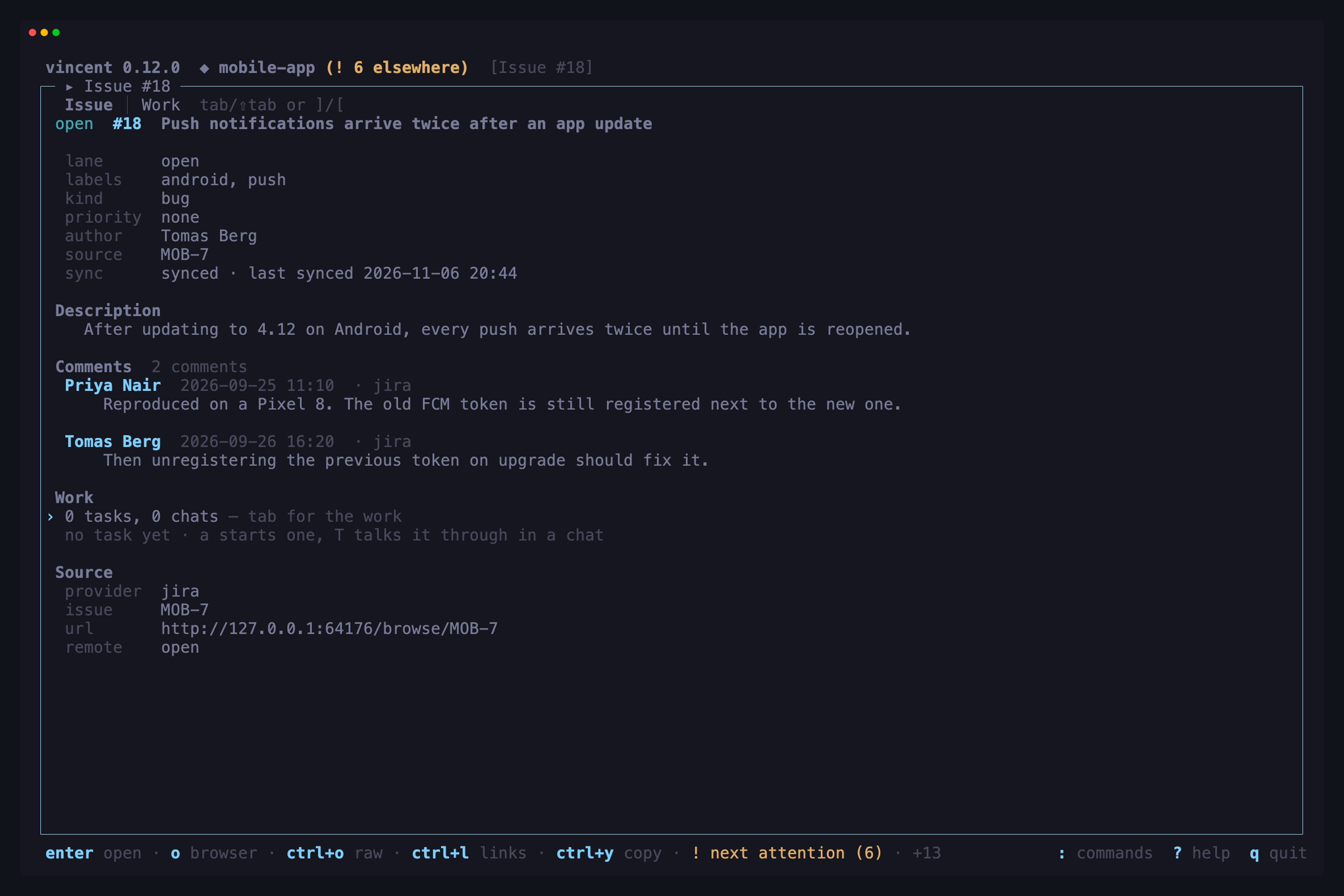
- Open or closed. A Jira issue is closed in vincent if and only if its status is in Jira’s Done category. Every other status — To Do, In Progress, In Review, any custom one — is open. The resolution never decides openness, and Jira’s in-progress statuses are not vincent lanes: an issue’s lane comes from the vincent work on it, not from its Jira status.
- Close reason. A closed issue’s reason comes from its resolution: one in
the duplicate set reads as
duplicate, one in the not-planned set asnot_planned, anything else ascompleted. When the resolution is empty, a Done status named Cancelled (or one in the not-planned set) reads asnot_planned. By default the duplicate set isDuplicateand the not-planned set isWon't do,Won't Fix,Cannot Reproduce,IncompleteandDeclined, compared case-insensitively; the binding’s mapping can replace either. - Kind is seeded from the Jira issue type on the first import only, and stays yours to change. Priority stays local and is never read from Jira.
- Labels are mirrored; one longer than vincent’s label limit is dropped.
- Body and comments are converted from Jira’s rendered HTML to Markdown.
An imported issue’s thread is Jira’s: vincent mirrors it and refuses a
person’s comment on it (
issue_mirrored).
Transition overrides
Jira has no open/closed field, so writing a close or reopen means picking a workflow transition. vincent picks the one transition the issue offers now that lands exactly where the change asks, and fails rather than guessing. When your workflow needs a hint, give the binding a mapping:
{
  "overrides": { "close_not_planned": "Won't do", "reopen": "Back to To Do" },
  "not_planned_resolutions": ["Won't Do", "Won't Fix"],
  "duplicate_resolutions": ["Duplicate"]
}
vincent project edit 1 --jira-mapping mapping.json
overrides names the transition for close_completed, close_not_planned,
close_duplicate and reopen; the two lists replace the resolution sets
above. Unknown fields are refused. The
API reference lists the rules.
Write-back
Only a person’s change is written to Jira, plus the writes of a handoff you granted:
- A person’s close or reopen of a Jira issue, from the TUI, the CLI or the API, is sent as one transition.
- A handoff whose
grant names
issue.closemay close or reopen its items, and one that namesissue.commentmay comment on them; a comment is posted as an Atlassian Document Format comment. - Anything else an agent asks for — over MCP, or a
vincentcommand run by a step or a chat — is refusedforge_write_needs_humanand nothing is sent.
A close as duplicate sets the Duplicate resolution and creates no issue
link. Writes go through the same outbox as GitHub’s: each is queued, retried
and counted on the project’s sync row (writes N pending, N failed, N
conflict), and an issue’s own sync field in vincent issue show carries
its reason. A write that gives up keeps the local state and fails with one
of:
| Reason | What to do |
|---|---|
no_transition |
No transition the issue offers lands there — say, no direct path from In Review to Done, or none at all because the account lacks Transition issues. Make the change in Jira, grant the permission, or add an override |
ambiguous_transition |
Several transitions qualify. Name one in the mapping’s overrides |
transition_needs_fields |
The matching transition’s screen requires a field vincent does not set. Make the field optional on that screen, or make the change in Jira |
no_write_scope |
Jira answered 403 to the write: the account may read the project but not change it. Grant it the permission, or use an account that has it |
While jira.enabled is false or jira.poll_interval is 0, writes are
not dropped: they wait pending with disabled, and are sent once both
are back on.
Close reasons on a default company-managed workflow
A company-managed project’s default Done transition still carries the
simplified workflow’s system:update-field post-function, which sets the
resolution to Done after the transition has run — even when its screen
offers Won’t Do or Duplicate and vincent chose one. Jira accepts the
transition, so the write succeeds, and the issue lands as Done. Jira’s API
does not show post-functions, so vincent cannot see this coming.
Jira wins the reason: the next import changes the issue’s close reason to
completed, and nothing is written again. It does not happen silently. The
issue’s sync field reads conflict with reason resolution_overridden
until its next write, the project’s sync row counts it as a conflict, and the
import’s issue.updated event carries reason_from and reason_to. Only
the first import after the write is read that way: once an import has read
the write back, someone changing the resolution in Jira later is an ordinary
edit there, adopted without the flag. To keep
not_planned and duplicate closes, remove the post-function from the Done
transition, or name a transition without it in the mapping’s
overrides.
Moved and missing issues
An issue moved to another Jira project is marked moved, and its key and
browse URL are updated to the new ones. An issue a pass can no longer read —
deleted, no longer visible to the account, archived, or outside the binding’s
JQL — is marked missing. vincent never deletes a Jira-imported issue:
the issue, its tasks and its thread stay, and it is marked live again if it
reappears.
Restricted comments
A Jira comment restricted to a group or role is never newly mirrored. A comment mirrored while it was public, and restricted in Jira afterwards, stays mirrored with the body it had.
Jira issues in workflows and triggers
A task created from a Jira issue gets:
- the title
PROJ-12 <title>, and the body followed by aJira issue PROJ-12: <url>line, all editable before the task exists; .Issue.Source.Keyin templates, andVINCENT_ISSUE_KEYin the environment of command, check and agent steps, holdingPROJ-12.
A Jira issue has no number: .Issue.Number is zero, number and
source.number are null in the VINCENT_ISSUE_FILE snapshot, and
VINCENT_ISSUE_NUMBER is not set. A workflow serving both trackers reads the
key. The github_issue, assignee and milestone prefill fields stay
GitHub-only. See Writing workflows for .Issue.
An issues trigger fires on
Jira-imported issues like any other, as by: sync. A Jira labeled or
unlabeled is untrusted — anyone who may edit a Jira issue may label it
— so a trigger on one must name allowed_actors. An issues trigger sees
opened, closed, reopened, labeled, unlabeled, lane_changed and
handoff_changed, never a move between two open Jira statuses. Every one of
those events by sync is untrusted — opened, closed and reopened for
every tracker — so an issues trigger that can match one must name
allowed_actors, which for a Jira issue are reporter display names (see
Trust).
Do not narrow the binding’s JQL to a status to start work when an issue
reaches Ready for Dev. An issue the binding’s JQL stops matching is marked
missing (see Moved and missing issues), so the
moment someone moves it on to In Progress its Jira close is no longer read
and a close in vincent is no longer written back. Keep the binding’s JQL on
something an issue keeps while it is worked on, such as a label, and start
Ready-for-Dev work with a
poll-script trigger. A
poll-script trigger also fits a Jira project vincent does not sync, or JQL
beyond what the binding narrows to. There is no type: jira.
Turning it off
jira.enabled: falseinconfig.yamlmakes no Jira call at all.jira.poll_interval: 0stops the sync pass.vincent project edit ID --issue-source none(orderive) unbinds one project; its Jira issues are kept and markedmissing.
Either switch holds write-back too, without dropping a queued write.
Troubleshooting
Every sync and write-back reason, and what to do about it, is in Troubleshooting → Jira.