From a wall of terminals to one control room
Running one agent in one terminal is easy to understand. Running several agents, commands, retries, and approval gates across multiple repositories is not.
The usual solution is a wall of terminal tabs. Each tab contains a partial story: one is still streaming, one stopped twenty minutes ago, one is waiting for an answer, and another finished on a branch whose name is no longer visible. The operator’s attention becomes the only thing connecting them.
Vincent’s TUI is designed around workloads rather than sessions.
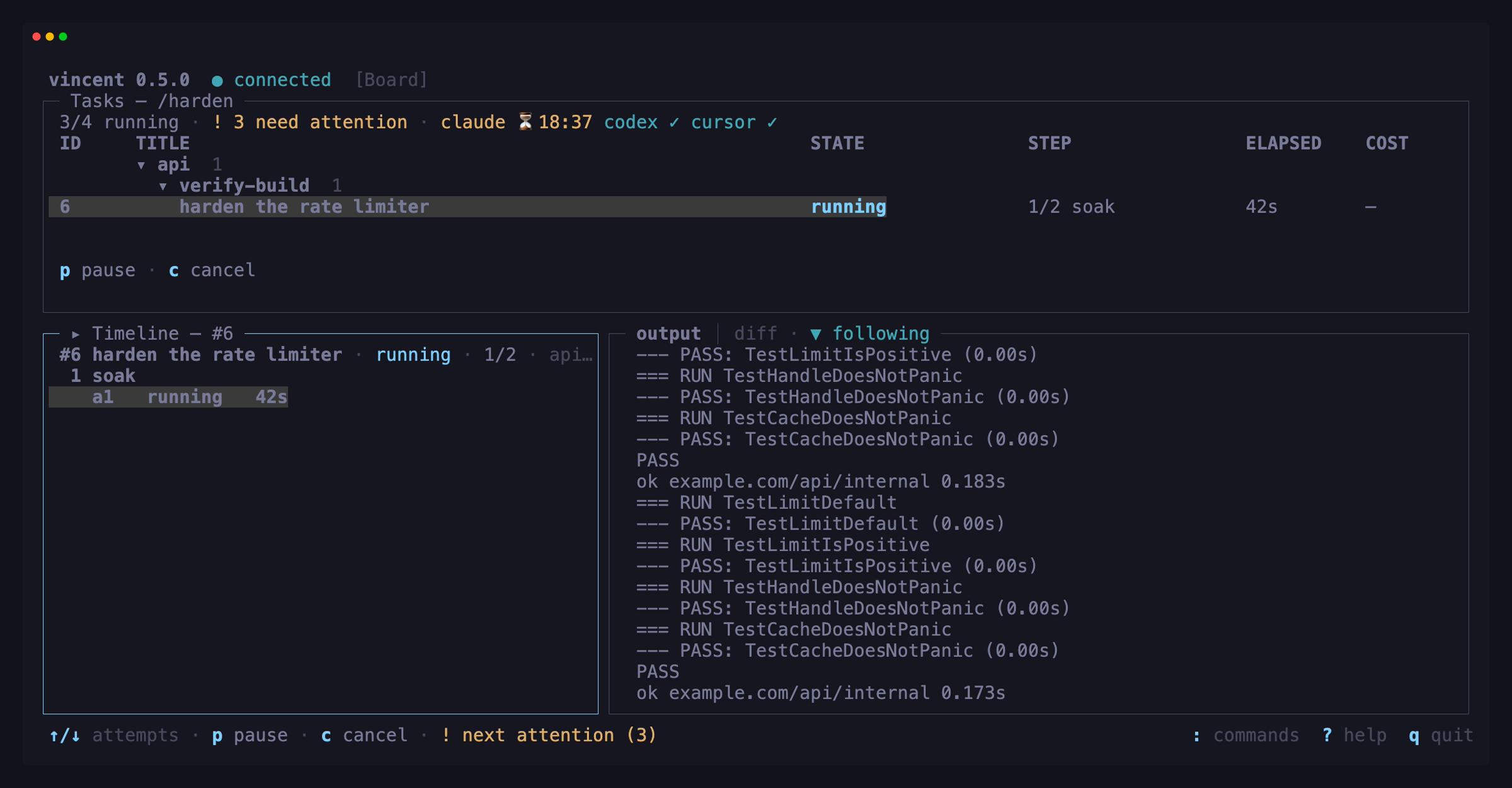
The board shows every task’s state, current step, elapsed time, reported cost when available, and the status message supplied by the running step. Filtering and grouping answer operational questions such as “what is blocked?” or “which project is consuming the queue?” without visiting every process individually.
Opening a task gives its steps, metadata, output, and diff separate full-screen tabs. A failed attempt remains visible after a retry. The diff is another tab on the same task, and the complete transcript can open in an editor when the summarized result is not enough. The interface preserves the distinction between vincent’s fixed failure reason and the free-text status the step reported about itself.
The workflow view provides a different kind of visibility. Its graph shows parallel groups, fan-out lanes, conditions, loops, checks, and includes before a task runs. The new-task flow presents declared inputs and overrides, then gives the complete request a final review stage.
Most importantly, the TUI does not own execution. It renders state from the daemon and sends actions the daemon has already declared valid for the task’s current state. Closing the interface does not stop the work. Reopening it does not reconstruct the story from terminal output; it reads the persisted story.
A control room should direct attention, not demand it continuously. Healthy work can stay in the background. Gates, questions, blocked steps, and failed checks become visible when they need a decision. That is what makes managing agentic workloads feel different from babysitting a collection of terminals.